Posts

New River periphrastics

Image
Neither new nor a river, they say of the New River. They say it’s a 400-year-old culvert, but it’s also a dividing line, an incredibly long and incredibly shallow reservoir, aquatically neurotic and geographically unreliable. It fragments neighbourhoods on the one hand – its embankments steep and impassable – and links them on the other – its vertical path an alignment from Canonbury to Ware. But it does so only every so often. Sometimes it is behind a steep fence. Sometimes it is underground. So while it’s true that the New River is neither new nor a river, it’s also not really a geographical feature of any kind, and its age is indeterminate, being as it is so varied and manipulated by the needs of the suburbs it surrounds.      Things start in Zone 3, Old Middlesex, Hornsey and Wood Green. The New River ran entirely above ground until urban development brought its tunnelling under. There’s one such tunnel in Wood Green; the land is for the most part landscaped gardens....

Taskmaster / Masktaster

Image
In one episode of Taskmaster, where the contestants are invited to bring in the "most spectacular picture of themselves", Hugh Dennis wears a picture of his face, on his face. He says he wears it because Hugh Dennis would never wear a mask of himself - so people assume that it must be someone else behind the mask. Hugh Dennis's admittedly banal picture of himself turns out to be an effective demonstration of the difference between comedians and people: the Hugh Dennis out doing his shopping, wearing the mask of Hugh Dennis, actually isn't the same person as the person he's wearing a mask of. He's wearing a mask of Stage Dennis; he's wearing the mask of character comedy. Hugh Dennis came last in the round for most spectacular picture. But his mask is a perfect demonstration of the wider context. Character comedy is very popular in the UK. The gist of the idea is that the comedian is playing a character that the comedian has created. Some of the most famous...

Reference for silos

Image
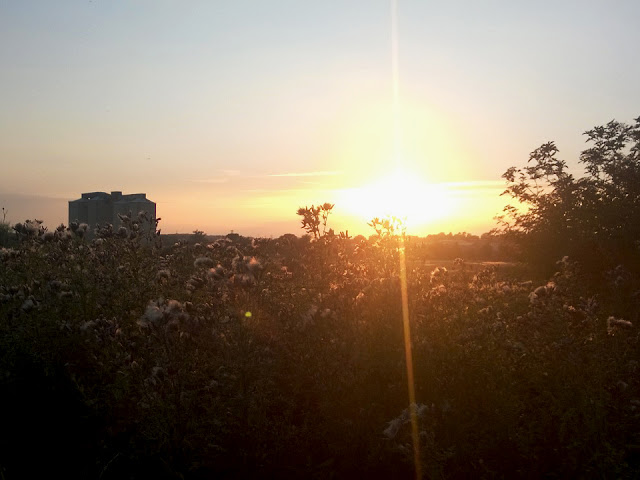
This is a piece I wrote for a life writing competition earlier this year. I don't have anything to show for it, but I liked it enough to zuzh it up and share at year's end. I hope you like it too, and here's to a merrier 2021... Pinned at the north end of the street I grew up on, the hill on London Road banks down, sharply, giving way to the River Gipping half a mile down the road. In the valley it creates, you can see miles to the west; the tree line is barely geography’s watermark on the blurred bound of the horizon. And there they rose up, stoic: four great silos, greyed out by time and bad business. It’s six months ago and I’m walking upriver. Something I used to do for adolescence’s sake, now an imitation, trying to draw nostalgia out from the undertow of adulthood. The Gipping is slack and in algal bloom. Just beyond the final railway bridge towards the edge of town, there is a path that veers right into a steep hillside of fresh weeds. I climb in expectation and find...

Notification fugue

Image
1: YOU'RE MY FAVOURITE NOTIFICATION There was a time when I had a Tumblr account - it was back in 2015, when I was in a retrospectively up-to-snuff relationship with a reliance on memes, references and other moment-to-moment signs. "You're my favourite notification" was a simple text post shared on the site, and it was one of those very memes. Customarily, we both liked, reblogged, and shared it ourselves. In doing so, we were recognising an appreciation for one another among a flurried fog of other visual cues. It was a kitschy message, but right for the times. In the gaps between the real and the simulated, between the relationships that exist and don't exist, between online and offline, it's almost impossible to maintain an identity. If I wanted to coin another phrase , I could say that notification fog has given way to notification fugue. They say that millennials have a problem with personal communication, but the truth is that personal communication has ...

Nationalise, regionalise, democratise: a treatise for New British Rail

Image
1. MY KINGDOM FOR A BRUNEL      It can often feel like the United Kingdom is eternally haunted by some Victorian spectre: from foreign relations, to architecture, to things wrapped in pastry, so much of the country harkens back to an imperial institutional dream - and it is a dream.      The railways of Great Britain, among the oldest in the world, are haunted in the same way. But they also suffer more recent spectres: British Rail, the state-run provider of passenger rail transport in Great Britain, has been dead for barely twenty five years. Now, the country runs a compromise. The tracks themselves sits in the public sector under Network Rail, following the dire safety concerns of privatised Railtrack. Meanwhile, the train operating companies (TOCs) and rolling stock companies (ROSCOs) are private tenders.      Crucially, however, Great Britain and the UK are not one and the same, and it is Great Britain that has part-privatised rail. Acros...

Albums of the year: 2020

Image
Last year, I wrote a blog detailing the albums I’d listened to throughout the year and the importance of developing a relationship between music and events. That we do so much better when we build our own recollections, as opposed to shoehorning the ones Spotify can provide for us. I’m doing it again this year with a slight of obligation: a sense that there wasn’t so much music this year that moved me. The Guardian called it “ the lost year ”, but I think a better term is “year in stasis”. Friends have told me how they spent the year in general and lockdowns in particular listening back to their summer favourites. Radio presenters have covered their favourite songs in every colour, from Craig Charles’ Funky Forty to Cilian Murphy’s Songs from Under the Stairs . For my own sake, in the unholy combination of a due return home and an undue expanse of free time, I have regressed to the music of my teenage years. Maybe I’m not the only one: being left to your own devices, not knowing how t...

Systematic Stress: Mark Fisher and mental health in lockdown

Image
“Come in later. Leave earlier… Even if you feel you don’t need to, I need you to. It’s good optics ”. I’m not the biggest fan of Industry – the BBC’s new drama, co-created with HBO – but I do like its incisive cynicism. The above quote is spoken by a manager, to her subordinate Gus, after Gus’ co-worker, Hari, has just died. Hari dies from working for roughly 72 hours straight, and the response from management is that his immediate colleagues at work should work fewer hours. But not for their sake. For the sake of the company. For the company’s optics . So the company can be seen to be acting on mental health. Gus is expected to change himself to solve the company's problem. The company culture won’t change; they’ll just change their  optics and then, once things simmer over, return to crushingly long hours. Gus privatises his losses. No one else carries his burden. It’s like he is being held responsible for the death of his friend at the hands of … is there any other way ...